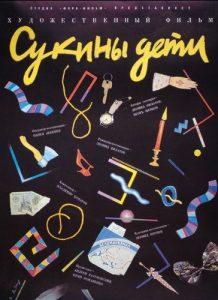
 Sons of Bitches (1990 film) – a Soviet feature film from 1990. Tragicomedy. A screen adaptation of the true story of the director of the Taganka Theatre Yuri Lyubimov
Production: Mosfilm studio, Ritm studio, Fora-film, USSR, 1990
Filmmaker:Leonid Filatov
Scriptwriter:Leonid Filatov
Starring:Vladimir Ilyin Larisa Udovichenko, Alexander Abdulov, Evgeny Evstigneev, Liya Akhedzhakova, Vladimir Samoilov, Elena Tsyplakova, Tatyana Kravchenko, Nina Shatskaya, Sergey Makovetsky
Duration:2 episodes 127 minutes
Plot of the film Sons of Bitches (1990 film):
The film dramatizes the difficult situation that arose at the Moscow Taganka Theatre in 1984. The central figure is Yuri Petrovich Lyubimov, the founder and permanent director of this famous theatre, known for its innovative productions.
In 1984, while abroad on an invitation to work on an opera production in Great Britain, Lyubimov publicly expressed critical remarks about censorship in Soviet theatre. These statements, disseminated by Western media, provoked a sharp reaction from the Soviet authorities.
В результате, указом Президиума Верховного Совета СССР от 10 июля 1984 года, Юрий Любимов был освобождён от должности руководителя Театра на Таганке. Это решение было мотивировано «недостойным поведением советского гражданина за рубежом».
In addition to his dismissal, Lyubimov was stripped of his Soviet citizenship by decree on July 17, 1984. This action by the authorities caused a wide resonance both in the USSR and beyond. Many cultural figures expressed support for Lyubimov. They considered the punishment disproportionate to the critical remarks made.
The film, based on these events, allows us to gain a deeper understanding of the atmosphere of that time, the difficulties faced by artists in the USSR, and the dramatic history of one of the country's most famous theaters.
The story of Lyubimov and the Taganka Theatre is a vivid example of the confrontation between an artist and the authorities, creativity and ideology. Lyubimov returned to the USSR and the Taganka Theatre only in 1988, after the beginning of perestroika. This period marked changes in the socio-political life of the country, including in the sphere of culture…